
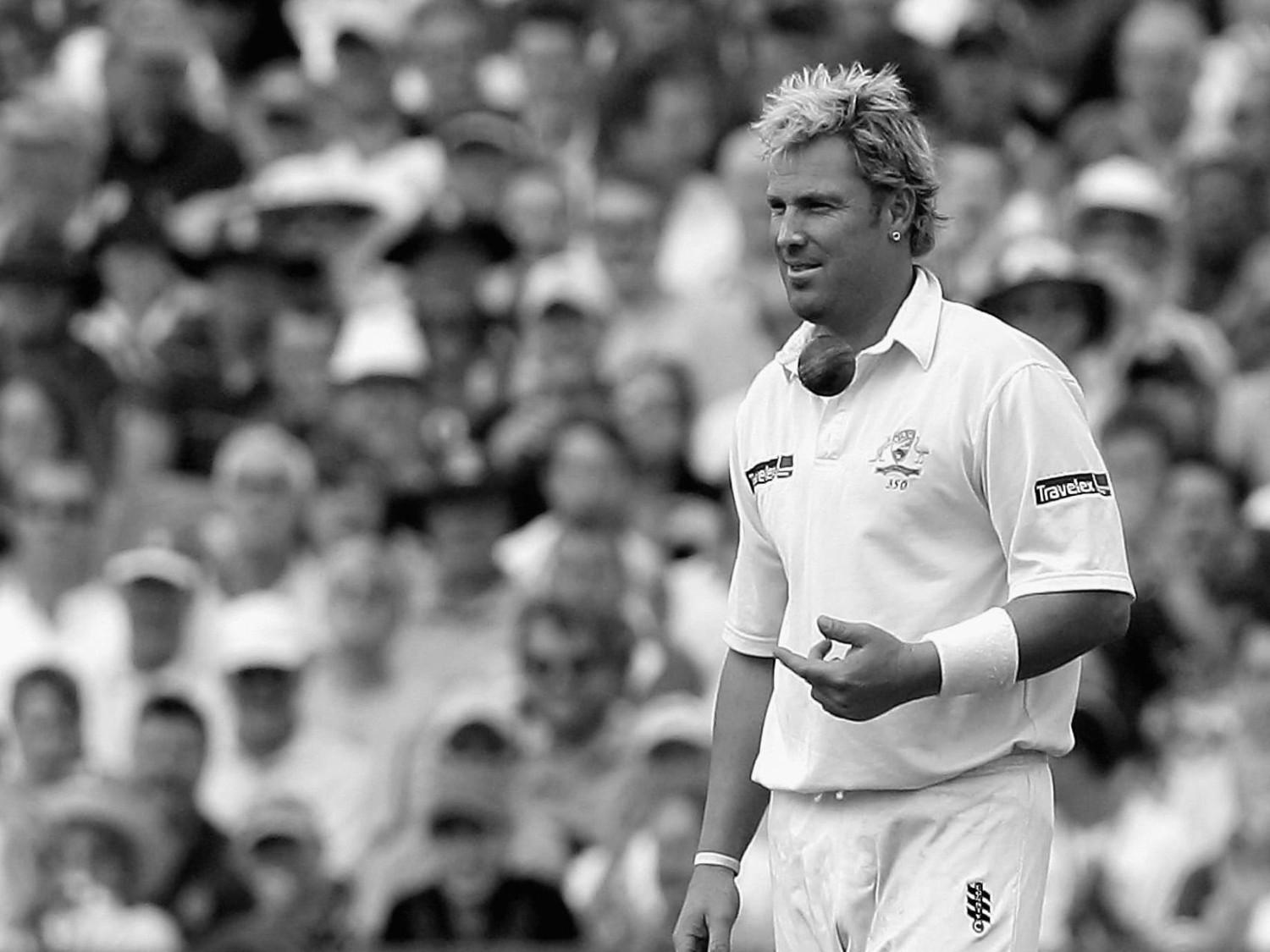
I suddenly remembered an evening from last year.
I was just about to leave the office when a female colleague came running toward me and thrust her phone in front of my eyes. The screen flashed:
“Big Breaking! Shane Warne is no more!”
Professional instinct dictates that in moments like these, not a second should be wasted — you head straight back to the desk and start writing the copy. Sports journalism, too, has its own grammar. There’s a fixed pattern to reporting the death of a sporting legend. One of the most important parts is gathering reactions — what other stars are saying about the legend’s passing.
From Virender Sehwag to Sachin Tendulkar to Brian Lara — there wasn’t a corner of the cricketing universe untouched by grief over the sudden death of Shane Warne. Everyone wrote about how shocked they were by the passing of arguably the greatest spinner of all time.
I still remember the finest tribute came from filmmaker Amartya Bhattacharyya. It was brief, but direct:
“As long as the ball spins, Shane will be alive.”
In essence: As long as cricket exists, Shane Warne will live on.
Born on this day in 1969, he would have turned 54 had he still been alive. Since his passing, he has been showered with one posthumous honor after another.
The comparison was always between Shane Warne and Muttiah Muralitharan. Some believe that if Warne had not been born in Australia — a country with pace-friendly pitches — but instead in India, Bangladesh, Sri Lanka, or Pakistan, he would have achieved even greater success than Muralitharan.
Others argue that he didn’t even need subcontinental spinning tracks. According to them, had Muralitharan not been accused of “chucking,” he would never have come close to Warne’s stature.
Are these claims unreasonable?
Statistics don’t entirely disagree.
On Sri Lanka’s spin-friendly turning tracks, Muralitharan averaged 19.57 and took 493 wickets. In comparison, on Australia’s pace-friendly wickets, Warne averaged 26.39 at home while taking 319 wickets.
Imagine this Shane Warne getting dusty spinning tracks match after match like Muralitharan did.
Let’s look at their Test statistics.
Muralitharan took 800 wickets in 133 Tests. Warne took 708 wickets in 145 Tests.
At first glance, Muralitharan appears ahead.
But there’s an important detail — 176 of Murali’s wickets came against relatively weaker teams like Bangladesh and Zimbabwe. Warne, meanwhile, played only three Tests against those two nations combined and took 17 wickets.
So what happens if we remove those matches from the equation?
Without Bangladesh and Zimbabwe, Muralitharan’s tally becomes 624 wickets in 108 Tests at an average of 24.87.
Warne, meanwhile, still stands at 691 wickets in 142 Tests at an average of 25.4.
Both were contemporaries. Both were among the greatest of all time. Both were spinners. Both took more than a thousand international wickets.
Yet amid all these similarities, there remains one subtle difference — and perhaps that single difference is what elevates Shane Warne’s place just a little above Muralitharan’s.

Delivering accurate, unbiased, and timely news from local stories to global events. Committed to truth, transparency, and responsible journalism.

Madhurima - Copyright . All rights reserved.
Delivering accurate, unbiased, and timely news from local stories to global events. Committed to truth, transparency, and responsible journalism.